


Echoes on the Alabaster Coast: Things to Do in Two Days in Dieppe, France

As the salty breeze off the English Channel met us on the high chalk cliffs of Normandy, Dieppe felt like an important stop in our road trip. We were on a grand journey that had begun amidst the bustling canals of Amsterdam and would eventually carry us across the channel to London. Now, arriving in Dieppe, we found a town where maritime grit and deep historical memory intertwine. If you are compiling your list of top things to do in Dieppe, you will quickly discover that this lively seaside town offers far more than scenic ocean views.

Along the way, each stop had added another layer to our European story. We had traded travel chaos for canal-side calm in Bruges and lingered for a few magical hours in Ghent. Crossing into France, we stood on solemn shores contemplating the echoes of Operation Dynamo in Dunkirk, before venturing inland to toast to history and Champagne in Reims and discover bubbly bliss in Épernay. We marvelled at soaring Gothic architecture during a few hours in Amiens, embraced the medieval soul of Normandy during one day in Rouen, took an unforgettable Mont-Saint-Michel day trip, and gaped at the dramatic arches and stunning garden of Étretat.
Nestled in a breach along the steep Alabaster Coast (Côte d’Albâtre), Dieppe’s story reaches back to the 7th century when Saxon fishermen named it after the Anglo-Saxon word for "deep" in a nod to its sheltered, deep-water harbour. By the 16th century, it had grown into one of France's premier maritime hubs. Navigators and cartographers departed from this shore to explore North America and map the New World. Later, in the 1800s, Dieppe transformed into France’s very first fashionable sea-bathing resort, drawing Parisian high society and famous painters like Turner, Pissarro, and Monet, who were captivated by the shifting light against the pebbled shore.

But for Canadian travellers, Dieppe carries an even deeper, more emotional resonance. On August 19, 1942, the smooth pebble beach became the site of Operation Jubilee—a disastrous Allied assault in which over 3,000 Canadian soldiers were killed, wounded, or captured. Standing on these cliffs today, the echoes of that sacrifice are palpable, making a visit to Dieppe as reflective as it is beautiful.

Table of Contents
2-Day Itinerary: Top Things to See & Do in Dieppe
Our Cozy Flat
Finding the right home base makes all the difference when exploring a coastal town on foot, and our apartment in Dieppe was an absolute gem. Tucked away on a quiet street just a few minutes’ walk from the beach, the flat was small but wonderfully cozy. It came equipped with a compact, modern kitchen, a beautifully updated bathroom, and an exceptionally comfortable bed. Two features made this stay particularly special for a longer road trip: accessible laundry facilities—a welcoming sight after weeks on the road—and a tranquil back garden. Starting the morning sipping hot coffee in the peaceful green yard, listening to the distant gulls and sea breeze, was a special treat.

Our host, Colin, was the epitome of local hospitality. He met us in person to hand over the keys and took the time to ensure we felt completely at home. He pointed out the best nearby boulangeries for morning pastries, mapped out local coffee shops, and shared the most scenic walking routes to reach the historic sites on our itinerary. That warm local touch set a wonderful tone for our two days in town.

Dieppe Beach (Plage de Dieppe)
Stepping onto Dieppe Beach, the first thing that strikes you is its remarkable scale. Stretching nearly two kilometres between towering, pale limestone headlands, this broad crescent shore is famously blanketed in millions of smooth, grey pebbles. At low tide, the receding water reveals a wide expanse of dark, firm sand, offering a completely different perspective of the shoreline.

In the 19th century, this expansive foreshore became the birthplace of French seaside resort culture. High society frequented these shores to indulge in the era's fashionable trend of sea-bathing. Victorian-era bathhouses and promenades sprang up, transforming the maritime town into an elegant coastal escape.
Yet, as you walk along the sea wall today, the beach’s beauty is layered with a solemn gravity. It was right here, across these open pebbles, that the 2nd Canadian Infantry Division bore the brunt of Operation Jubilee on August 19, 1942. Exposed to heavy fire from the cliffs above, thousands of brave soldiers landed. Walking along the shoreline today is a deeply moving experience—a place where the grandeur of nature and the gravity of history meet in quiet contemplation.
Practical Visitor Info:
Address: Boulevard de Verdun, 76200 Dieppe
Hours: Open 24/7
Cost: Free
Sunset Dinner at L’O2mer
After a full day of seaside air, dining right along the water was the perfect way to spend the evening. On the recommendation of our host Colin, who kindly called ahead and booked a table for us, we headed to L’O2mer, a lovely beachfront establishment positioned directly along Boulevard de Verdun with front-row views of the English Channel.

As the sun began to set, casting golden and violet hues across the sea, we settled in for a truly superb meal. L’O2mer's menu strikes a fantastic balance for all palates, offering an impressive array of fresh, locally sourced seafood mains alongside expertly prepared meat and vegetarian dishes.
For my main course, I opted for the faux filet, which arrived wonderfully seasoned, seared to perfection, and incredibly tender. Pairing it with a chilled glass of Champagne felt like a fitting nod to the bubbly region we had explored earlier in our road trip. To top off the evening, I treated myself to a dessert: a huge serving of Rum and Pineapple Glace Coupée. The rich, velvety ice cream infused with warm rum flavours was pure indulgence. Dining as the sky darkened over the Channel remains one of the culinary highlights of our entire trip.
Practical Visitor Info:
Address: 101 Boulevard de Verdun, 76200 Dieppe (located at Les Bains)
Hours: Tuesday to Sunday, 12:00 PM–2:30 PM & 7:00 PM–9:00 PM (Closed Mondays)
Cost: À la carte; mains range from €18–€32
Traveller's Tip: Ask your host or hotel concierge to book a window table in advance to secure the absolute best sunset views over the water.
Square du Canada
At the base of the western headland, right where the town meets the towering chalk cliffs below the château, lies Square du Canada. This serene, meticulously manicured park serves as a poignant sanctuary of remembrance and a testament to centuries of shared history between France and Canada.

At the heart of the park stands the Stèle du Canada, a striking stone monument engraved with a chronicle that dates back long before the World Wars. It honours the early French explorers and navigators who set sail from the port of Dieppe in the 16th and 17th centuries to explore, trade, and settle across what would become New France.
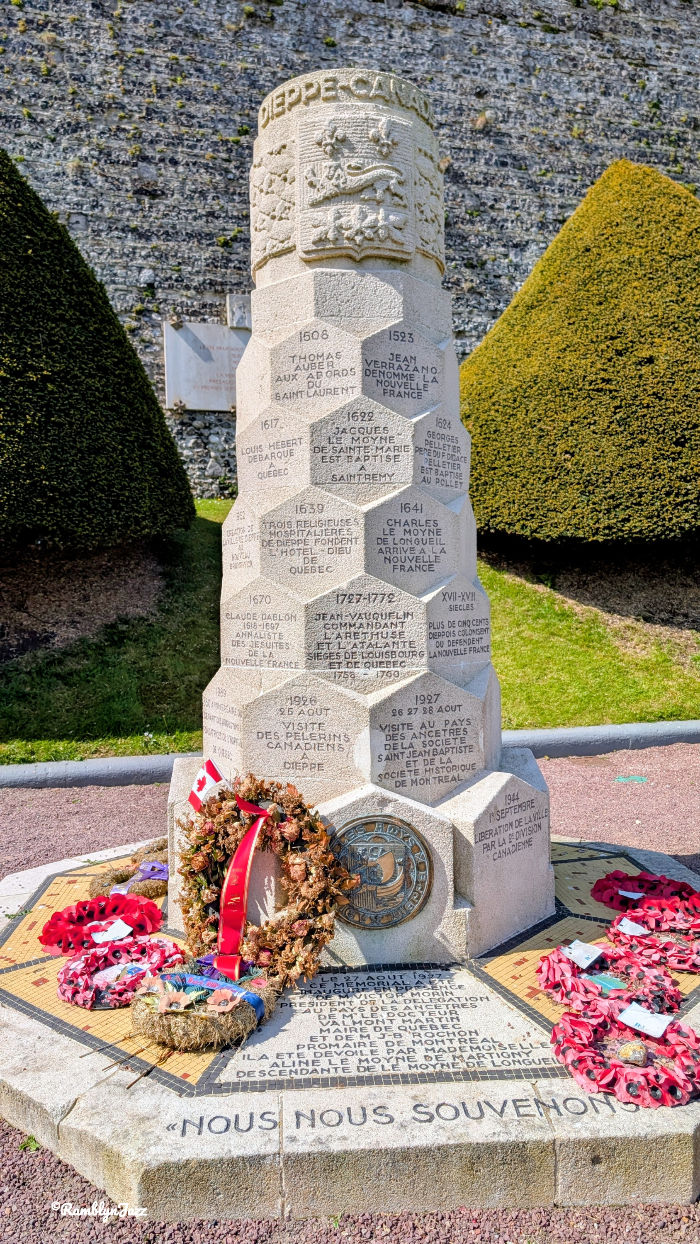
Yet, for modern visitors, particularly Canadians, the park's most powerful resonance stems from August 19, 1942. The manicured lawns, vibrant flower beds, and commemorative plaques honour the men of the 2nd Canadian Infantry Division who fought on the beaches just steps away during Operation Jubilee. Standing in the quiet shadow of the limestone cliffs, surrounded by commemorative wreaths and the soft murmur of the ocean, offers a deeply reflective pause on any Normandy journey. It is a place of profound quiet beauty that connects two nations separated by an ocean.

Practical Visitor Info:
Address: Rue Alexandre Dumas / Boulevard de Verdun, 76200 Dieppe
Hours: Open daily during daylight hours
Cost: Free
Dieppe Castle (Château de Dieppe)
Perched high on the western cliff overlooking the town and the vast expanse of the English Channel, the Château de Dieppe is the town's most imposing landmark. Built in the 14th century out of flint and sandstone to protect the harbour against English raids, this formidable fortress features round defensive towers, thick stone curtains, and sweeping views of the coastline below. Today, the castle houses the Musée de Dieppe, celebrated for its world-class collection of intricate ivory carvings—a traditional craft that thrived in Dieppe from the 16th through 19th centuries—alongside maritime artifacts and Impressionist paintings.

Unfortunately, we were not able to visit the interior museum during our stay. The castle is closed on Mondays, and with our packed schedule along the coast, we simply ran out of time.

Even without stepping inside, visiting the site was well worth the trek. We thoroughly enjoyed wandering around the dramatic exterior walls, admiring the centuries-old masonry and taking in the panoramic vistas of the pebbled shoreline below, before continuing along the scenic walking path that leads higher along the cliff tops.

Practical Visitor Info:
Address: Rue de Chastes, 76200 Dieppe
Hours: Wednesday to Sunday, 10:00 AM – 12:00 PM & 2:00 PM – 6:00 PM (June–Sept); closed Mondays and Tuesdays.
Cost: Approx. €4.50 for museum entry; grounds/exterior walk are free.
Cliff Walk & WWII German Bunkers
Continuing along the coastal footpath past the château leads to the high chalk headlands of the Côte d’Albâtre. As you follow the clifftop trail, the vast expanse of the English Channel opens up around you, offering breathtaking panoramic views that stretch for miles along Normandy's coastline.
Dotted along the grassy heights are the weathered remnants of WWII German concrete bunkers and strongpoints (Widerstandsnest), constructed as part of Hitler’s Atlantic Wall defensive network. Seeing these heavy concrete fortifications graffitied and overgrown with wild coastal grasses creates a striking juxtaposition of natural beauty and dark history.

Standing on the edge of these high cliffs looking directly down at the pebble beach below provides a sobering tactical perspective. From up here, it becomes painfully clear why the Allied troops faced such overwhelming odds during Operation Jubilee in 1942. Exposed to heavy crossfire from these elevated vantage points, the Allied forces fought courageously on the beach far below. Walking this path is both a magnificent coastal hike and a humbling lesson in military history.
Practical Visitor Info:
Starting Point: Coastal footpath trailhead located just behind Château de Dieppe
Hours: Open daily during daylight hours
Cost: Free
Traveller's Tip: Stick strictly to marked paths, as the chalk cliffs undergo natural erosion and can be unstable near the edge. Bring a windbreaker and wear comfortable walking shoes with good traction.
Historic Town Walk: Villa Vénitienne & Église Saint-Rémy
Leaving the heights of the cliffs and descending back into Dieppe's historic core reveals a town rich in architectural variety. Wandering through the pedestrianized streets and quiet side lanes provides a wonderful look into local life away from the waterfront crowds.
One of the most surprising architectural gems tucked within the historic quarter is the Villa Vénitienne (located along Rue Chaste). In a region dominated by traditional Norman timber-framed homes and flint masonry, this striking private residence stands out with its intricate Italianate arches, ornate balconies, and Venetian-inspired facade, reflecting the eclectic tastes of the wealthy patrons who frequented Dieppe during its 19th-century heyday as a fashionable resort.

A short walk away stands the magnificent Église Saint-Rémy. Built between the 16th and 17th centuries to replace an earlier church destroyed during conflict, this landmark blends Gothic structural grandeur with refined Renaissance details.

Practical Visitor Info:
Église Saint-Rémy Address: Place Saint-Rémy, 76200 Dieppe
Hours: Open daily for quiet visits during daylight hours (typically 9:00 AM – 6:00 PM, except during services)
Cost: Free
Dieppe Harbour (Port de Dieppe) & Quai Henri IV
No visit to Dieppe is complete without taking a slow walk around the vibrant Port de Dieppe. Serving as the maritime heart of the town for over a thousand years, this deep-water harbour remains a lively, working port where commercial fishing trawlers, sleek sailing yachts, and passenger ferries share the sheltered basins.

The focal point for visitors is Quai Henri IV, a bustling waterfront promenade lined with tall, colourful historic townhouses, lively seafood brasseries, and sunlit outdoor terraces. Walking along the quay as the morning fog lifts or during late afternoon light is pure Normandy charm. You can watch local fishermen landing their daily catches at France's top fishing port.

Practical Visitor Info:
Location: Quai Henri IV / Bassin Duquesne, 76200 Dieppe
Hours: Open 24/7
Cost: Free to explore
Final Thoughts
As our two days in Dieppe came to an end, I found myself sitting on our quiet garden patio one last time, listening to the gentle bird song and enjoying the sun. There is an unmistakable depth to Dieppe—a quiet resilience that resonates long after you leave its shores.
Unlike more commercialized coastal resorts, Dieppe does not hide its working-class maritime roots or its complex, emotional past. It invites you to wander slowly: to reflect before the memorials at Square du Canada, to feel small beneath the towering chalk cliffs, to trace centuries of architectural history through the historic streets, and to savour the simple joy of exceptional food with front-row views of the English Channel.
As we prepared to pack up our flat and resume our journey toward Calais, where we would take the ferry across the Channel to Dover, Dieppe proved to be far more than just another scenic stop on our European road trip. It was a place of contemplation, connection, and subtle coastal beauty—a quiet Normandy haven that lingers in the heart long after the horizon fades.

If you enjoy the content and would like to be updated with new posts, become a member/subscribe (it's free!) or follow along on the RamblynJazz Facebook page, BlueSky, Pinterest, Twitter, and Instagram. You can help the blog grow by sharing the link with a travelling friend or through social media. I truly appreciate your comments and encourage you to share your thoughts below.


Dieppe strikes me as a great place to go off the grid for a day or two. Very serene, just going with a slow pace and genuinely authentic and grounded living. I can see how you connected with the town through staying with a local, following his recommendations for an excellent meal and the ties to Canada. I looked its location up on Google Maps and have dropped some pins.
Carolin | <a href="https://solotravelstory.com/">Solo Travel Story</a>
Dieppe looks so charming. It also looks like many an English seaside town, although arguably probably worth better pastries. While I am always interested in the northern France history, it's even more unique to hear about the Canadian connection. I'd like to see more about that when visiting. Shame you didn't get into the Chateau museum, it looks nice. But this definitely seems the kind of place you wouldn't be mad about having to visit again
I had only really known Dieppe to be a port, so it was lovely to read about the many and varied places to visit. The cliffs of the beach look very familiar. My Canadian grandfather was in the D-Day landings so it was particularly poignant to see the Stèle du Canada. I know we would enjoy exploring the Château de Dieppe, I love the construction. And the dinner at L’O2mer looked divine.