


One Day in Rouen, Normandy

Every great road trip has its bridge cities—those places that sit quietly between the headline acts, waiting to surprise you. As we mapped out our journey from the winding waterways of Amsterdam toward our final destination in London, we knew the miles between would be rich with history. We had already navigated the initial travel chaos to find quiet, canal-side calm in Bruges, and spent a few magical hours admiring the medieval architectural grandeur of Ghent. We had paused to listen to the sombre, historic echoes of Operation Dynamo on the sands of Dunkirk, chased the effervescent heritage of kings and champagne through Reims, and savoured the bubbly bliss of a day trip in Épernay.
Yet, after a brief but beautiful afternoon stop to stretch our legs in Amiens, the landscape began to shift. The wide-open spaces gave way to something older, denser, and distinctly more weathered. Our wheels were officially rolling into the capital of Normandy. Rouen wasn't a place we planned to linger in for weeks, but rather a chapter we wanted to read closely for a single, focused day. What we found was a city wrapped in timber, stained glass, and a timeless, dramatic flair.
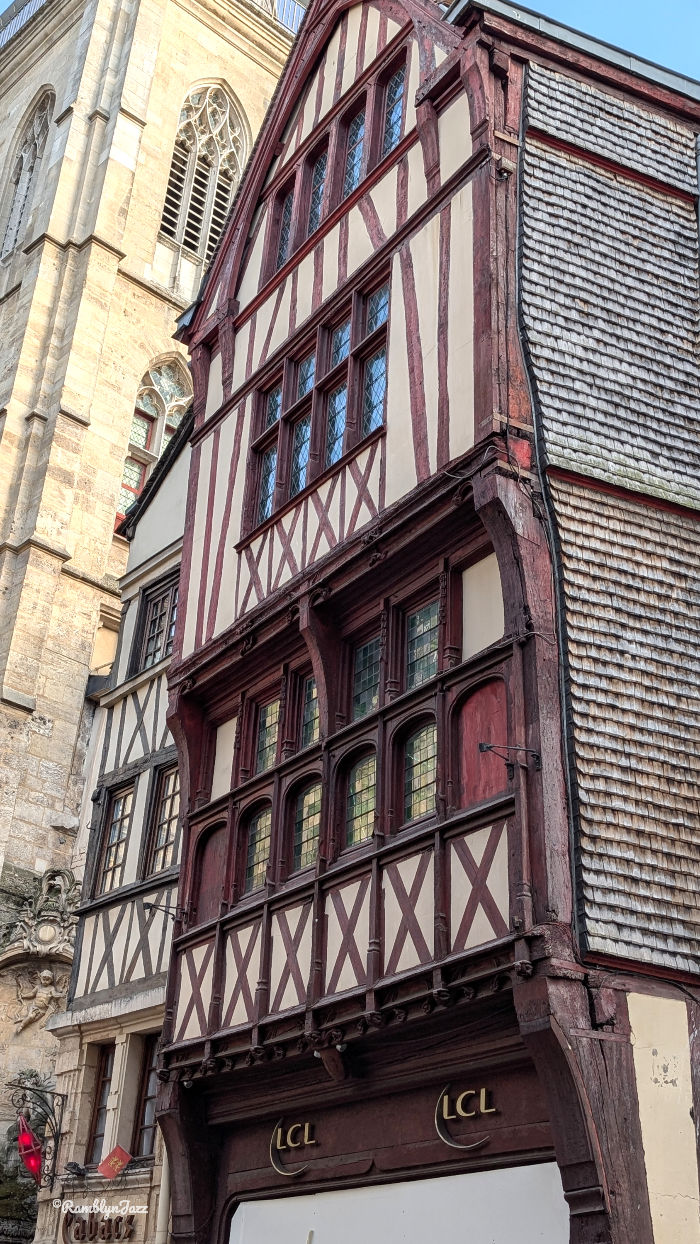
Table of Contents
The Spirit of Normandy
Rouen grew up as a vital trading hub, deeply French yet profoundly shaped by its Norse roots. It was here in the early tenth century that the Viking leader Rollo established the Duchy of Normandy, setting off a lineage of fierce warrior-dukes—including William the Conqueror—who would reshape the map of Europe.
Culturally and culinarily, Normandy walks to its own rhythm. Unlike much of France, this is not wine country; it is a land of orchards, lush pastures, and deep, savoury traditions. The region is celebrated globally for its rich dairy and apple harvests, yielding world-famous creations such as creamy Camembert cheese, sparkling apple ciders, and Calvados apple brandy.
Visually, the entire region is defined by its architectural postcard: the stunning colombage, or half-timbered house. In Rouen's old town, these structures stand shoulder to shoulder by the hundreds. Built using exposed structural oak beams packed with clay and straw, they lean over the narrow cobblestones, their upper floors jutting outward. Painted in deep earth tones, muted ochres, and historic blues, they give the city a beautifully weathered, living-museum quality that instantly captures the imagination.

Arriving in the Old City
After checking into our lovely local flat, we left our luggage behind and set out on foot toward the pedestrianized core of the old city to discover what wonders it held and to find a spot for dinner. We arrived just as the Rouen Tattoo Festival was winding down, and the timing lent the city a uniquely energetic, eclectic atmosphere. This wasn't a military display, but rather a celebration of ink and art, bringing together top-tier tattoo artists from around the world alongside a lineup of live musical acts.
As we walked, we found ourselves weaving through lingering crowds still buzzing from the music and creative energy. The ambient chatter of festival-goers mingled with the sharp, rhythmic metallic clang of stages being packed up and artists' exhibition booths being disassembled by the event crews. The security barricades that had closed off the ancient quarters for the day were slowly being pulled aside. Bit by bit, the historic streets began to open back up to the evening air, revealing the quiet cobblestones underneath and welcoming the regular rhythm of city life. It felt as though we were catching Rouen right as it exhaled, stripping off its modern, alternative festival costume to reveal its timeless medieval skeleton beneath.

The Highlights: Exploring Rouen in a Day
With only twenty-four hours to absorb the city, we focused our energy on the historic core. Rouen is remarkably compact, meaning you can easily cover its most monumental landmarks on foot. Here are the top things to see and do if you find yourself on a similarly swift itinerary.
Le Gros Horloge (The Great Clock)
As you wander down the main pedestrian thoroughfare, it is impossible to miss the arresting sight of Le Gros Horloge arching gracefully over the street. This magnificent fourteenth-century astronomical clock is an engineering marvel and a powerful monument to civic independence, constructed by the citizens of Rouen to assert their economic identity free from royal interference. The Renaissance archway features beautifully detailed stone carvings, while the clock face itself features a brilliant gold-and-blue dial. Rather than just telling the hour, it tracks the phases of the moon on a globe above the dial and displays the days of the week via a rotating wheel at the base, each represented by an allegorical figure.
Address: Rue du Gros Horloge, 76000 Rouen
Cost: Free to view and photograph from the street. Admission to climb the belfry and view the interior museum is €7.50 for adults.
Hours: Street viewing is accessible 24/7. The Belfry Museum is open Tuesday to Sunday, 10:00 AM – 1:00 PM and 2:00 PM – 6:00 PM (April to October).

Cathédrale Notre-Dame de Rouen (Rouen Cathedral)
A short walk away lies the towering Cathédrale Notre-Dame de Rouen, a staggering masterpiece that showcases the evolution of Gothic architecture over several centuries. The stone facade is so incredibly detailed, laced with intricate spires, buttresses, and countless sculptures, that it resembles frozen lace. It famously captivated the Impressionist master Claude Monet, who set up a studio across the square to paint the facade more than thirty times, capturing how the shifting sunlight and colours re-created the building from dawn to dusk. Inside, the cathedral carries immense historical gravity; it is the final resting place of the formidable Richard the Lionheart, King of England and Duke of Normandy, whose heart is buried within the choir. Boasting the tallest church spire in France, it remains an unforgettable anchor of the city's skyline.
Address: Place de la Cathédrale, 76000 Rouen
Cost: Free admission.
Hours: Open Monday 2:00 PM – 7:00 PM, Tuesday to Saturday 9:00 AM – 7:00 PM, and Sunday 8:00 AM – 7:00 PM.

Place du Vieux-Marché (The Old Market Square)
Eventually, the historic streets open up into the wide, bustling Place du Vieux-Marché. This vibrant square is the social heart of Rouen, ringed by beautifully restored half-timbered buildings, crowded café terraces, and a lively covered market hall. However, its historical significance is deeply sombre. This is the exact site where Joan of Arc, the teenage peasant girl turned military heroine, was burned at the stake by the English in 1431 during the Hundred Years' War. Walking the modern square is a poignant experience; a massive, elegant concrete cross now rises over the stones to mark the precise spot of her execution, serving as a quiet place of reflection amidst the daily hum of modern French life.
Address: Place du Vieux-Marché, 76000 Rouen
Cost: Free to explore the square and outdoor memorial sites.
Hours: Open 24/7; individual market stalls and surrounding shops keep standard daytime hours.

Église Sainte-Jeanne-d'Arc (Church of Saint Joan of Arc)
Standing right in the center of the Old Market Square is the Église Sainte-Jeanne-d'Arc, a fascinating piece of twentieth-century architecture that presents a radical departure from the surrounding medieval timbers. Completed in 1979, its bold, sweeping roofline is designed to look like an overturned Viking longship from one angle and the roaring, licking flames of a bonfire from another—a direct architectural nod to both the region's roots and Joan's tragic end.
We were disappointed that we could not visit inside because we arrived too late. We were hoping to see the famous north wall, which is constructed almost entirely out of magnificent sixteenth-century stained-glass windows. These treasures were painstakingly salvaged from the Church of Saint-Vincent before it was entirely destroyed by bombings during World War II, and now find a second life here, bathing this modern sanctuary in brilliant, historic colours. When you visit, make sure you arrive during opening hours so you don't miss out.
Address: Place du Vieux-Marché, 76000 Rouen
Cost: Free admission.
Hours: Open daily from 10:00 AM – 12:30 PM and 2:00 PM – 6:00 PM (closes at 5:30 PM from November to March).

Dinner and People Watching at Le JM’s Café
By the time we finished exploring, the crisp northern air was beginning to make itself felt. It was an undeniably chilly Normandy evening, the kind that whispers for you to head indoors, but the terrace at Le JM’s Café caught our eye. Situated right in the lively expanse of the Place du Vieux-Marché, its patio was still beautifully kissed by the evening sun's last warm rays. We decided to brave the temperature for the sake of the view, pulling up a couple of chairs where the sunlight could reach us.
To be entirely candid, the culinary side of the evening wasn't the headline act of our trip. I settled on a comforting, straightforward order of chicken and chips. When it arrived, it proved to be perfectly fine—cooked well enough and completely edible, but ultimately nothing spectacular or memorable to write home about. In reflection, I wish we had chosen somewhere we could have enjoyed some of the famous camembert and had known to order the cider and apple brandy. However, what the menu lacked in flair, the experience more than made up for in atmosphere. The service was notably warm, attentive, and efficient, and the real value of the evening lay in our front-row seats to the square. Lingering over our drinks on that sunlit terrace, we enjoyed some truly fantastic local people-watching as Rouen transitioned from daytime sightseeing to its relaxed evening groove.

Final Thoughts
In reflection, my impression of Rouen was admittedly fleeting and remained very much on the surface. We did not plunge deeply into its hidden alleyways, nor did we uncover the quiet residential secrets that reveal themselves only to those who stay for a week. We came as true road-trippers: pausing, observing, and moving onward.
Yet, there is a beauty in that kind of brevity. Within the span of a single afternoon and evening, we were able to visit every one of the city's major historical sites, look up at the soaring Gothic heights that captivated Monet, and stand in the moving silence of the square where Joan of Arc met her fate. For those mapping out a fast-paced Normandy itinerary or driving across borders as we were, a single day doesn't feel rushed—it feels complete. Rouen delivers its monumental history efficiently and beautifully, proving that you do not always need ample time for an ancient city to leave its mark on you.
If you enjoy the content and would like to be updated with new posts, become a member/subscribe (it's free!) or follow along on the RamblynJazz Facebook page, BlueSky, Pinterest, Twitter, and Instagram. You can help the blog grow by sharing the link with a travelling friend or through social media. I truly appreciate your comments and encourage you to share your thoughts below.


Rouen is probably my top choice if I ever planned a vaccation actively in France, since I am so intrigued by the Jeanne D'Arc story and the city's significant role in the country's history. I also love the timbred grade listed II houses (just so insanely pretty!) and appreciate to hear that the centre is compact and walkable. You have to join me so we can both experience Rouen on a deeper level and explore some of its narrow side alleys and secrets.
Carolin | <a href="https://solotravelstory.com/">Solo Travel Story</a>
I last visited Rouen as a teenager as my high school French pen pal was from there. I can remember very little about the city other than its cathedral, clock, and the beautiful half-timbered buildings. I'd love to go back and see it again as an adult and, obviously, as a teen the cider and apple brandy wasn't on the menu so I'd have to give that a try!
Rouen might be my favorite French city (shh, don't tell Paris). I have a fondness for it as I "lived" there on a work experience trip in high school for 2 weeks. I love the Joan of Arc church, so interesting, although don't feel bad about not getting inside, I swear that thing is hardly ever open. I'd recommend the JoA history museum if you go back though. The cathedral is also really pretty, but mostly I just love walking around looking at the old buildings
You're right that there is beauty in brevity but it looks as though you had a splendid time in Rouen. I love the city's prettiness - the colombage is absolutely charming. I know we would enjoy strolling through the streets and would marvel at Le Gros Horloge - it really is magnificent. I can see how the Jeanne d'Arc connection would be hugely poignant. The architecture of the church dedicated to her is fascinating. And thanks for the heads-up that we should seek camembert with cider and calvados!