


Whitehorse Highlight: The Yukon Wildlife Preserve

While extended road trips are an annual ritual for me, this summer's journey marked my very first venture into the rugged, far reaches of northern British Columbia and across the territorial border into the Yukon. Venturing into this northern landscape was a breathtaking adventure, where daylight stretched on endlessly, and every turn revealed views wilder and grander than anything I had previously explored.
This expedition kicked off with the storied milestone at Dawson Creek, BC, Mile 0 of the Alaska Highway, tracing the historic route as it winds past emerald valleys from Dawson Creek to Fort Nelson. From there, the road cut deeper into true wilderness between Fort Nelson and Liard River, before crossing boundary lines on the stretch from Liard Hot Springs to Watson Lake, Yukon. Finally, after conquering the scenic tarmac from Watson Lake to Whitehorse, I rolled my van into the territorial capital. For readers just joining the journey, check out the links to see what you've missed and stick around for future posts as my adventures continue.
Whitehorse offers no shortage of northern charm, but one experience surpassed every expectation: spending an unhurried day at the Yukon Wildlife Preserve. Tucked into the Ibex Valley just half an hour outside the city centre, this remarkable sanctuary became one of my absolute favourite highlights of the entire Yukon journey.

Table of Contents
A Wildlife Enthusiast’s Dilemma
As an avid wildlife enthusiast, I find the Alaska Highway an intoxicating drive. My senses were on high alert, scanning the treeline for telltale shapes of moose, deer, black bear, or a herd of wood bison. Experiencing wildlife from behind the wheel brings a peculiar kind of heartbreak. Stopping a heavy camper van safely along narrow northern shoulders can be challenging, and more often than not, the moment the engine idled and my hand reached for the camera, the animal had already dissolved like a ghost into the dense forests.
Even when sightings linger, ethical viewing along public corridors can be unsettling. The impulse to brake abruptly, crowd animals with idling vehicles, or provoke a reaction for a snapshot does immense disservice to wild creatures. For me, safety and animal welfare come first: roadside feeding or crowding stressed animals on highway verges is a hard "no."
That conscientious approach makes choosing where to see animals intentionally a very delicate decision. I harbour deep reservations about traditional captive facilities and will only support an operation if it meets stringent standards. It cannot exist purely for tourist curiosity; it must be firmly rooted in conservation, education, and genuine rehabilitation. The animals must live in massive, natural environments where they can forage, retreat from sightlines, and behave naturally without feeling cornered.

The Yukon Wildlife Preserve easily met that high bar. With the rigorous distinction of being accredited by Canada’s Accredited Zoos and Aquariums (CAZA), the facility functions as a protected haven and operates the only dedicated wildlife rehabilitation centre in the Yukon. Knowing my admission fee went directly toward expert veterinary care, animal rescue, and preserving northern species put my mind at ease before I took my first step through the gates.
How to Explore the Yukon Wildlife Preserve
Set roughly 30 kilometres northwest of downtown Whitehorse along the Takhini Hot Springs Road, the preserve sits cradled within the broad, sun-washed expanse of the Ibex Valley. It makes for an effortless, peaceful day trip from the territorial capital, whisking you away from urban streets and into the dramatic, open valleys of the northern landscape.
What immediately distinguishes the Yukon Wildlife Preserve is its sheer, breathtaking scale. Spanning over 700 pristine acres, it feels less like an animal attraction and more like an untamed territorial park with gentle boundaries. The grounds encompass a patchwork of distinct, naturally occurring northern ecosystems, including open sub-alpine grasslands, dense boreal spruce forest, waterlogged willow wetlands, and a dramatic, soaring limestone cliff face. Fences are set deep into the natural terrain and treelines, giving residents genuine room to roam, graze, and retreat from view entirely on their own terms.

Navigating this vast sanctuary revolves around a well-tended, five-kilometre gravel double loop designed in a rough figure-eight. Preserve vehicles are the only ones on the pathways, and they are scarce, creating a quiet, peaceful environment.

Visitors can explore on foot or by bike, taking anywhere from two to three hours (longer if you are a meanderer like me!). For visitors with mobility challenges, or those keeping to a tighter itinerary, the preserve operates 90-minute guided bus tours. These low-floor, accessible buses crawl gently along the double loop, led by experienced naturalists whose commentary weaves together territorial ecology, Indigenous stewardship, and the individual rescue histories of the resident animals. I chose to walk the pathways.

Ethical Field Notes & The Great Lens Blunder
Before diving into the specific encounters along the trail, I need to confess. In the whirlwind of packing and prepping the van for thousands of kilometres on the road, I committed the ultimate cardinal sin of wildlife travel: I left my good camera and long telephoto zoom lens sitting comfortably at home. Throughout the highway drive, every fleeting bear or distant raptor stung with regret, but that oversight never felt more keenly than during my day at the preserve.
With authentic enclosures stretching across dozens of rolling acres, the animals here are free to graze and rest at completely natural distances. That meant my trusty Google Pixel phone camera was pushed to its absolute limits. While modern smartphone optics and software are miraculous for sweeping northern landscapes, they simply cannot bridge a hundred metres of open meadow when a herd of muskoxen decides to bed down near the far spruce line. My images turned out adequate enough to serve as treasured personal souvenirs, but they hardly do justice to these creatures' majesty. Standing on that quiet gravel road, I made a solemn vow right then and there: I will return, and next time, my proper camera body and tripod will be the first items stowed securely in the van.

Setting technical mishaps aside, exploring the preserve offers an invaluable lesson in stillness. In conventional zoo environments, animals are often penned into tight enclosures where viewing is instant and artificial. Here, the experience demands patience and respect. Sometimes you must stand quietly along the fence line for ten or fifteen minutes, binocular cups pressed to your eyes, simply scanning the shadows of an aspen grove before a resting woodland caribou or a camouflaged lynx reveals itself.
The Preserve's Rehabilitation Work
Equally heartening is knowing what happens behind the visible enclosures. Tucked discreetly away from the visitor trails is the Yukon's only dedicated wildlife rehabilitation facility, operating round the clock to treat injured, sick, or orphaned wild animals from across the territory. While the preserve's permanent residents serve as ambassadors for their wild counterparts, the rehab centre works quietly toward a single, selfless goal: healing northern wildlife through specialized veterinary medicine, with the explicit aim of returning them to their wild homes whenever possible. Supporting a sanctuary where animal welfare and rehabilitation take unconditional precedence over tourist entertainment made every single step along that five-kilometre path feel meaningful.
Habitat by Habitat
Walking the gravel loop is a journey across a living map of the sub-Arctic, where each bend reveals a distinct ecological zone shaped to mirror the North's natural habitats.
The Mountain Crags: Dall’s Sheep and Mountain Goats
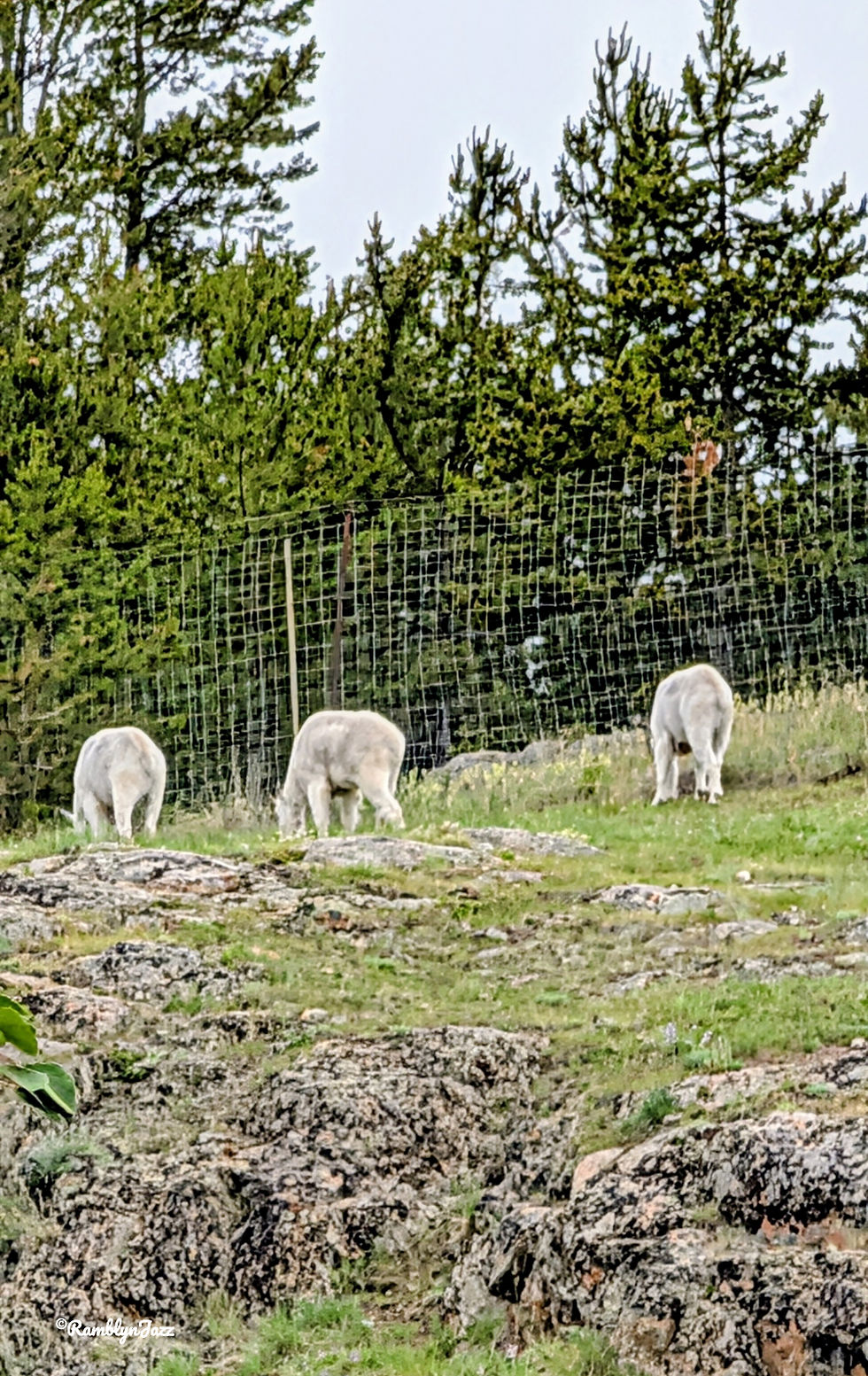
The most visually striking backdrop on the property is a towering limestone cliff face that rises nearly a hundred metres into the sky and stretches along the ridge for almost a full kilometre. Here, the preserve’s high-altitude ungulates thrive in an environment that demands incredible athletic agility. Scanning the pale, fractured rock face reveals Dall’s sheep, easily identifiable by their pristine white coats and the sweeping, amber curls of the rams' horns. Sharing the craggy inclines are mountain goats, whose muscular shoulders, dense double coats, and dagger-like black horns look entirely at home as they navigate narrow stone ledges that seem utterly impassable to human eyes.

This habitat is furthest from visitor pathways and really requires a zoom lens and binoculars to see the animals clearly.
The Wetland Marsh: Moose
Moving down into the valley basin, the landscape gives way to a sprawling natural wetland thick with willow shrubs, sedges, and shallow marsh pools. This is prime territory for moose. Unlike fleeting highway encounters, watching a massive bull or cow browse unhurriedly among the reeds allows you to appreciate their sheer, imposing stature. They wade calmly through the muck, submerging their long muzzles to tear away aquatic vegetation, surrounded by the plants that sustain them in the wild. I was absolutely delighted by the youngster who found me as interesting as I found him.

The Open Plains: Wood Bison and Elk
In the sweeping sub-alpine grasslands, you'll encounter the bison and elk, which are much bigger than I expected. The wood bison, distinguished by their pronounced forward hump and dark, woolly capes, graze across the rolling pastures in tight, family-centred herds.

Sharing the adjacent meadow expanse are the elk, whose antler spreads and resonant calls carry clearly across the quiet valley.

The Northern Tundra: Woodland Caribou and Muskoxen
Farther along the loop, the vegetation shifts toward gravel plains and sparse scrub, introducing the caribou and muskoxen. The woodland caribou (also known as reindeer) roam this terrain with regal poise, their crescent-shaped hooves designed to function like snowshoes across spongy muskeg and deep winter drifts.

Nearby, you encounter the muskoxen. Their sweeping, curved horn bosses and shaggy skirts of windproof outer hair conceal a legendary under-layer of "qiviut" (wool eight times warmer than sheep’s fleece) that lets them shrug off the most savage Arctic blizzards without a shudder. Unfortunately for me, they stayed at the far edge of their habitat.

The Forest Edge: Mule Deer
Where the grasslands meet the forest, the atmosphere turns quieter. This sheltered transition zone is home to mule deer, whose delicate footwork and famously oversized, radar-like ears make them models of vigilance. They tend to linger in the dappled shade of the tree line, grazing on tender herbs and shrubs, their white-rimmed tails and gentle brown eyes offering a serene contrast to the imposing presence of the larger herd species. I had seen many mule deer disappear into the forest during my drive, but here I could get closer and appreciate their beautiful faces and rather large ears!
The Shaded Woodlands: Canada Lynx and Northern Foxes
Tucked within dense, mature boreal woods are the enclosures dedicated to the preserve’s smaller, stealthy carnivores. The Canada lynx enclosure offers ample seclusion, with fallen timber and shaded platforms that suit their reclusive nature. Catching a glimpse of one is a quiet thrill, from its prominent ear tufts and flared facial ruffs to its impossibly wide, fur-padded paws that let it glide silently over deep snow. At the preserve, two female lynxes (a mother and daughter) live in separate enclosures. Both were fairly active. These are large, dangerous cats with gentle faces.

In adjacent woodlands, curious northern foxes dart through brush piles and investigate hollow logs, their keen eyes and quicksilver movements demonstrating the sharp wits required to survive in the Subarctic. I watched a grand, 3-legged fellow prowl his enclosure, hunting an unknown prey.

Practical Visiting Tips
A visit to the Yukon Wildlife Preserve is rewarding year-round, though each season paints the Ibex Valley in a different light. If you visit during late spring or early summer, you will likely be greeted by the wobbly steps of newborn bison calves, caribou calves, and young thinhorn sheep scampering across the rocks. Late autumn brings dramatic rutting displays against the colourful foliage. I imagine a winter visit wrapped in a beautiful frosty wonderland. The guide collecting my entrance fee told me that in winter, the animals are at their most magnificent, with dense, frosty coats, heavy ruffs, and full layers of qiviut.
Arriving during the day makes a noticeable difference in animal activity. Planning to walk the loop either first thing in the morning when gates open or in the late afternoon rewards you with cooler air and far livelier herds, as animals move out from the tree lines to forage across the meadows. Midday visits during high summer often see species lounging quietly in shaded aspen hollows, requiring a little extra squinting and patience.

Coming prepared will turn a good visit into an unforgettable one. Wear sturdy walking footwear with good tread, and always carry extra layers, as northern breezes funnelling through the valley can drop the temperature rapidly even beneath blue skies. Most importantly, bring a quality pair of binoculars to scan the cliff faces and woodland edges, carry plenty of drinking water, and take heed of my packing mishap: do not leave your telephoto camera behind.
Final Thoughts
Watching these magnificent northern animals thrive in an ethical, wide-open habitat was a pause my long drive along the Alaska Highway truly needed. It was an experience that will easily draw me back up the highway for years to come.
If you enjoy the content and would like to be updated with new posts, become a member/subscribe (it's free!) or follow along on the RamblynJazz Facebook page, BlueSky, Pinterest, Twitter, and Instagram. You can help the blog grow by sharing the link with a travelling friend or through social media. I truly appreciate your comments and encourage you to share your thoughts below.


Comments